Struggling with constant backtalk or being ignored? Here are 15 Surprising Reasons Why Your Child Doesn’t Listen and what to do when your child doesn’t listen — without yelling, punishments, or power struggles.
“Come on! I’ve asked you three times already… just put your shoes on!”
Sound familiar?
You’re standing at the door, late for work, your child’s half-dressed and singing to their toy dinosaur like you don’t exist. You feel the tension rise in your chest. You want to scream. Maybe you do. They still don’t move.
The big question we usually ask at this moment is: “How do I get them to listen?”
But here’s the secret:
Flip the script to
👉 “I wonder WHY they’re not listening right now?”
This question is a total game-changer. Why?
Because it shifts you out of frustration and into curiosity. And from curiosity, you get clarity—and real solutions.
It puts you back in charge, not by forcing compliance, but by understanding behaviour.
Let’s get to the heart of it. When we say “listen,” what we really mean is cooperate. And here’s why they often don’t:

15 Reasons Your Child Isn’t Cooperating (Even Though You’ve Told Them 100 Times)
1. They’re deeply engrossed in play
Children aren’t ignoring you to be difficult—they’re in flow. Play is their language, their learning. You’re interrupting their “work” without warning.
Imagine you’re in the middle of writing an important email or finally enjoying your first hot cup of tea all day… and someone suddenly barks, “Come on, let’s go!” You probably wouldn’t jump up instantly either.
It’s the same for children. They’re not being defiant—they’re immersed in their world, and we’re pulling them out without notice.
What helps: Go to them. Gently touch their shoulder or get down to their level. Make eye contact. Give them a heads-up: “In two minutes, we’re putting the Lego down to get shoes on.”
A heads-up helps their brain shift gears—and they help you avoid the drama.
2. You’re giving too many instructions at once
“Put your socks on, brush your teeth, pack your bag and don’t forget your book!”
Feels like a lot?
It is a lot. Young children—especially under 7—struggle to hold and follow multiple-step directions. Their brains just aren’t built for that level of working memory yet.
What helps: One simple instruction at a time. Pause. Let them succeed. THEN give the next one. They feel capable, not overwhelmed. Over time, this builds confidence and momentum.
3. You’re remembering everything for them
Ever feel like you’re getting sick of your own voice?
That constant loop of reminders—“Don’t forget your water bottle!”, “Did you bring your reading book?”, “Have you packed your PE kit?”—can feel never-ending.
And it might be a sign that you’re doing too much of the thinking for them.
Have you heard the saying: “A child who always forgets is a parent who always remembers”?
If we carry the full mental load, they don’t get to practise the skills of organising, remembering, and taking responsibility. Their “remembering muscle” doesn’t get a chance to grow.
What helps: Start small. Visual checklists, morning routine cards, or asking, “What do you think you might need for school today?” all shift the responsibility to them, bit by bit. You’re not abandoning them—you’re coaching them to independence. This is how we raise capable kids who feel proud, not reliant.

4. You’ve told them what to do… but not how
We often assume they should just know. But that’s like being handed a brand-new job with no training. Imagine turning up on your first day and being told, “Sort this spreadsheet, run the meeting, and don’t mess it up”—with no explanation, no demo, and no support. You’d feel lost, stressed, maybe even frozen.
Children feel the same way when we ask them to do something they haven’t had enough practice with. And even if they’ve done it before, that doesn’t guarantee they’ll be able to do it right now. Tiredness, emotions, distractions—all of these impact their capacity in the moment.
What helps: Coach the skills. You don’t need to do it for them, but with them—until it becomes second nature. Learning takes repetition, not reminders.
5. Expectations are too high
Sometimes we forget that children are still learning and developing. If your three-year-old can’t sit still at the table, or your five-year-old forgets every instruction, it’s often not defiance—it’s just where they’re at developmentally.
The real challenge comes when our expectations don’t match reality. That’s when frustration builds, and we can lose our cool.
We tend to think things should be different, instead of meeting both ourselves and our child with acceptance and empathy. It’s from this place of understanding that we can uncover practical, lasting solutions together.
What helps: Pause and ask yourself, “Is this expectation age-appropriate? Have I taught this skill clearly?” When needed, lower the bar and scaffold the rest. Meeting your child where they are sets you both up for success and calmer cooperation.
6. When their brain is overwhelmed — cooperation goes out the window
Tired, hungry, overstimulated, or feeling powerless — these moments can push your child’s brain into survival mode. In this state, their ability to listen or cooperate shuts down because they’re overwhelmed and can’t process what’s being asked of them.
It’s not about defiance or ignoring you; it’s their brain’s way of coping with stress and discomfort. Trying to push cooperation in this state usually leads to frustration for both of you.
What helps: Tune in to what they need first. A snack, some quiet time, a hug, or simply a chance to breathe can help their nervous system calm down. Once they feel safe and regulated, they’re far more able to engage, listen, and cooperate.
7. They don’t feel heard
This is a BIG one and the foundation of the coaching model I use and teach. If children feel dismissed, corrected, or overpowered all day, they naturally withdraw or push back. Either way, cooperation drops off.
The truth is: for our kids to truly listen, they MUST feel heard first. It’s just how children work. The very first tool I teach parents is all about helping their kids feel understood and acknowledged.— and it can truly change your life and your child’s behaviour.
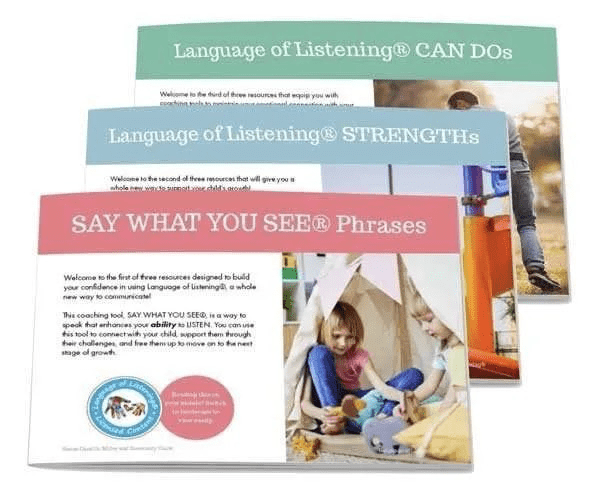
What helps: Use the first tool called Say What You See “You really wanted to keep playing, huh?” or “You’re feeling upset right now.” When kids feel genuinely heard, they become far more willing to hear you in return.
Want everyday examples of how to use this powerful tool? Grab your copy of my 3 eBooks. packed with simple, practical ways to transform communication and cooperation with your child.
8. You’re not modelling cooperation
Remember, listening equals cooperation—and children learn this by watching how we act. Just like they pick up on empathy by seeing and feeling it from us, they learn cooperation in the same way.
As parents, it’s easy to rush through the day, however, involving your child in everyday tasks shows them what cooperation really means. When we tidy up together or share small responsibilities, it helps them understand that everyone plays a part.
What helps: Set up times in the day that work for your family to build cooperation into your routine. This might be tidying up together after playtime or sharing simple tasks at mealtimes. When cooperation becomes part of your everyday rhythm, kids experience it firsthand and are more likely to mirror it.
9. Kids have needs that just gotta be met
All behaviour meets a need. If your child feels disconnected, unseen, powerless or overwhelmed—they will find someway to meet that need, even if it’s through behaviour that drives you up the wall.
Example: A child craving connection might whine, pester, or act up—because even negative attention feels better than no attention.
But when we meet their needs proactively? We get willing cooperation.
This is one of the biggest transformations I support parents with.
When you finally understand what your child is really asking for—and how to respond in a way that gets results without yelling or giving in—it changes everything.
Home stops feeling like a battleground and starts feeling like a family again.
If you’re ready for that shift… this is the work we do together. Inside my coaching program. I show you exactly how to meet your child’s needs without losing yourself.
What helps: Get curious. What’s behind the behaviour? When we meet kids’ needs before the meltdown, cooperation becomes natural.
10. They don’t have enough say
I once heard that young kids hear over 50 commands every half hour. Oh my!
“Put your shoes on.” “Eat your toast.” “Sit still.” “Hurry up.”
When kids feel ordered around all day, they push back. Not because they’re trying to be difficult—but because they have a natural, healthy drive for autonomy.When kids don’t feel like they have any say, they grab it the only way they know how: resistance.
What helps: The “Can Do” tool. (From the Language of Listening framework.) It gives your child meaningful choice within clear limits, so they feel capable and in control—while you stay in charge.
Small shifts like this build cooperation naturally because kids feel seen and empowered instead of pushed.
This is one of the key tools I share with parents—and it truly changes the way families connect and get along.
Want a simple, practical way to bring this into your daily routine? Click here to download my FREE Guide – How To Hold Boundaries Without Power Struggles

11. It’s a power struggle
Oh my, I know all too well—when the kids aren’t listening, it’s so easy to get stuck in a power struggle. And before you know it, you have a full-on standoff over who’s going to pick up a dropped sock! Getting caught in this battle of wills is a sure-fire way to have your kids dig their heels in even more.
Kids naturally want to feel some control over their world. When they don’t get that, they often grab power the only way they know how—by saying “No.” It’s rarely about the socks or the shoes; it’s about their need for autonomy and independence.
What helps: Instead, offering small, manageable choices helps your child meet their need for power in more effective ways.
12. You say “No” too often
“Don’t jump!” “Stop shouting!” “No, no, no!” Sound familiar?
Here’s the thing—our kids aren’t trying to push buttons. But their brains don’t process negative commands the way adults do. When you say “Don’t jump,” their brain hears “Jump.”
When “No” becomes the soundtrack of their day, kids get confused, frustrated, and less cooperative.
What helps: Say what you do want. For example, “Keep your feet on the ground,” “Use your inside voice,” or “Let’s walk.” This guides behaviour much more effectively.

13. Don’t ask questions if you don’t want them to say no!
I once overheard a mum at the park call out, “Will you please come here?!” Her little girl shouted “NO!” and bolted in the opposite direction. The mum turned to me, clearly frustrated, and said, “Ugh, she never listens!”
And I smiled, (quietly to myself)… because actually? She did listen. The mum asked a question—and the child answered.
It just wasn’t the answer she wanted.
Kids don’t catch the nuance in our words. They hear a question and respond literally. If it sounds like a choice, they treat it like one.
What helps: Make a clear, kind statement instead. “Please come here now.”
It’s not about being harsh—it’s about giving clear leadership. When kids know what’s expected, it’s easier for them to follow through.
14. You’re using threats or ultimatums
“Put your toys away or no TV tonight!”
“If you don’t eat your dinner, no dessert!”
We often reach for threats when we’re desperate. But here’s the truth: threat-based parenting is one of the biggest predictors of a stressful home environment. It creates power struggles, erodes trust, and often escalates behaviour rather than calming it.
Yes, you might get short-term compliance—but at a cost.
What helps: Focus on coaching. When we help our child meet their needs within our boundaries, they learn how to regulate, problem-solve, and respect limits—without needing to be pushed there.
It’s not about giving in. It’s about leading with connection and clarity. That’s when true cooperation happens.
15. You’re not managing your own stress (and they pick up on it)
When life gets busy and overwhelming, it’s hard to show up as the calm, patient parent you want to be.
Kids are incredibly perceptive—they pick up on your stress, even when you don’t say a word. If you’re rushed, frustrated, or worn out, they sense it—and often react in ways that feel challenging. It’s not about them being difficult; it’s about them responding to the energy around them.
What helps: You don’t have to be perfect, but noticing your own stress and naming it gently can change the dynamic.
Try saying: “I’m feeling a bit overwhelmed right now, so let’s take a moment to breathe together.”
When you model this kind of honesty and self-care, you teach your child that it’s okay to have big feelings—and how to handle them with kindness.
Final Thoughts
Remember that – Listening doesn’t mean obey. Listening means connection and cooperation.
Parenting isn’t about controlling your child’s behaviour — it’s about understanding what’s really going on and guiding them to cooperation. – it’s focusing on this is what’s going to get you kids who want to listen to you.
These 15 insights help you shift from the daily battles to real connection and cooperation. They make parenting feel clearer, calmer, and a lot more enjoyable.
The next time your child “won’t listen”, pause and ask:
“I wonder why they’re struggling right now?”
That question alone is the first step to becoming what I call a Parenting Detective—someone who knows exactly why a behaviour is happening, and what to do about it.
It’s not about being perfect. And it’s definitely not your fault if no one ever showed you this way of parenting. This is what I teach:
✅ Empowerment.
✅ Confidence.
✅ Calm leadership.
You get to be in charge—not by yelling, but by understanding. You get the behaviour you want and a deeply connected relationship, built on trust, respect and willing cooperation.
At your wit’s end with your child’s behaviour and looking for something that really works? Want a simple, actionable plan that can start making a difference in just a few minutes a day?
The Language of Listening Collection, £15
Get immediate access to 3 eBooks with practical tools and step by step guidance to better behaviour and more joy at home
Page by page you’ll find easy and practical solutions to real life dilemmas faced by parents, just like you.
No punishments, bribes, or rewards needed—just happy kids and even happier parents!

Feeling overwhelmed with parenting challenges? Get online parenting support now.

You don’t have to figure this all out on your own.
If parenting feels harder than it should—more shouting, more resistance, more guilt than you ever expected—I’m here to help.
I offer 1:1 parent coaching for families who want more ease, more laughter, and more connection at home.
As a qualified, authorised parenting coach, I bring practical tools and compassionate support to help you create the kind of family life you actually want.
Think of me as your calm, non-judgy guide—someone who gets it, and who walks beside you as you turn the hard moments into meaningful change.
What other parents are saying after working with me:
“Camilla was the answer to our prayers. I am endlessly grateful to her and only wish I’d found her sooner.” Louisa, Mum of 2
“Camilla coached us through different methods. Methods which I had never thought about, but gave us incredible results in a very short space of time, methods which we still use now and are so easy to implement on a daily basis. I am no longer the shouty mum I used to be. And my relationship with my kids has changed so much, I often wonder why I hadn’t started this journey sooner.’ Lucy, Mum of 3
“I was stuck in a pretty unpleasant vicious circle, with three awesome small children and was ruining it. I was afraid they would grow up and not trust me. Within the first couple of weeks working with Camilla I saw positive changes.” Claire, Mum of 3