
Have you ever thought: ‘Why does my child behave for everyone else, but not for me?’ I used to wonder the same thing.
My daughter was an absolute angel at school—teachers praised her, other parents told me how polite and kind she was. And then, the moment she stepped through our front door, everything changed.
Suddenly she was snapping, refusing, pushing back at every turn.
I remember thinking: How can this be the same child?
If you’ve ever felt that sinking feeling—“Why is it only me?”—you’re not alone.
And if you’ve tried all the usual tips (stricter rules, more rewards, new consequences) only to find yourself right back in the same battle, you know how frustrating it feels.
The truth is, mainstream advice often has us looking in the wrong places. Defiance at home isn’t about “fixing” your child—or yourself. It’s about noticing what’s really driving the behaviour.

Why Your Child is Only Defiant at Home
Here are four reasons kids may seem fine everywhere else, but push back at home.
As a parenting coach, I’m trained to spot these hidden patterns and pinpoint exactly what’s going on. There’s no blame or shame—just that huge sense of relief parents often describe as: “Ohhh… now it makes perfect sense!”
1. Hidden Cycles You Don’t Notice
When kids only act out at home, it’s often part of a repeated cycle:
When a child is defiant only at home, it’s often because you’ve both slipped into a cycle without realising it.
It usually looks like this:
Child reacts → parent reacts → child pushes harder → parent digs in → both sides escalate.
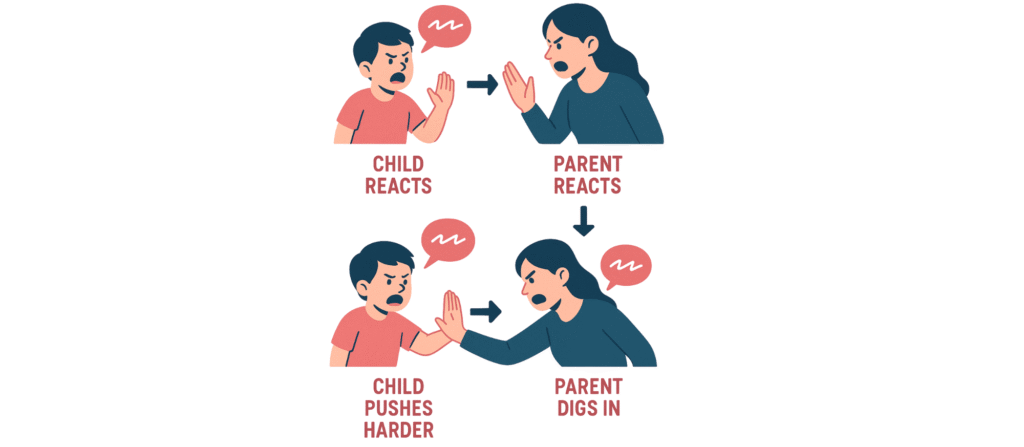
And suddenly, you’re in the exact same battle you had yesterday.
Neither of you is trying to make things worse—but the back-and-forth reinforces itself. The more it happens, the more both of you expect it to happen.
Once parents learn to spot this cycle, they realise the behaviour wasn’t random or personal. That shift alone can be life-changing.
2. Personality Clashes
Sometimes the problem isn’t the behaviour at all—it’s a mismatch in personalities.
For example:
-
A strong-willed child paired with a parent who values order and compliance.
-
An energetic, big-feelings child paired with a parent who values calm and quiet.
-
A child who thrives on independence paired with a parent who needs things done “just so.”
These natural differences can cause daily friction, especially at home where both of you feel safest to be yourselves.
What feels like “defiance” is often just your child’s temperament bumping up against yours.
The good news?
Once you understand the clash, you can adjust your approach—not by changing who you are, or who your child is, but by finding ways to work together and bringing out the best in each other.
It’s not about compromising or giving in. It’s about recognising each other’s strengths and needs, and then creating a dynamic where both of you feel respected.
When parents shift how they respond, what felt like constant battles can turn into opportunities to connect and cooperate.

3. Core Beliefs You Bring Into Parenting
Every parent carries core beliefs into family life—these are the deep “rules” we absorbed in childhood about how children should behave and how parents should respond.
Often, we don’t even realise we’re carrying them until they get triggered in the heat of the moment.
Some common ones sound like:
-
“Children should always respect adults.”
-
“If I give an inch, they’ll take a mile.”
-
“Good parents stay in control at all times.”
Our negative core beliefs can actually fuel the very conflict we’re trying to avoid.
Take that second one: “If I give an inch, they’ll take a mile.”
When a child argues about bedtime, a parent with this belief might feel they must hold firm no matter what—otherwise they’ll “lose control.”
That often leads to digging in, raising their voice, or adding stricter consequences.
The child then digs in too, and the power struggle intensifies.
And here’s the important part: your child’s response doesn’t just fuel the struggle—it also reinforces the belief you already hold.
If your core belief is “If I give an inch, they’ll take a mile,” then every protest or pushback feels like proof you were right all along. But in reality, it’s the way you interpret their behaviour that keeps that belief going.
When you start to see their pushback differently, you create space for new responses, and the belief begins to loosen its grip.
4. Techniques That Don’t Work (and Make Things Worse)
So many parents tell me: “I’ve tried everything—rewards, punishments, stricter rules—and nothing works.”
That’s because most mainstream strategies only focus on controlling behaviour, not understanding it.
For example:
-
Sticker charts can motivate for a while, but once the novelty wears off, the behaviour returns.
-
Consequences or punishments often make kids more defiant, not less, because they feel misunderstood or unheard.
-
Constantly tightening rules can leave everyone walking on eggshells, waiting for the next explosion.
The harder we try to “fix” the behaviour with surface-level techniques, the more stuck we feel.
Real change happens when parents start looking under the behaviour—to the feelings, needs, and patterns driving it.
That’s when responses actually work, because they’re aimed at the root of the problem.

Why This Feels So Hard.
Here’s the tricky part: you can’t always see what’s driving the behaviour in your own home.
You’re too close. It’s like standing in the middle of a forest—you only see the trees in front of you, not the bigger path.
That’s why so much of the advice out there leaves parents feeling like they’re failing. It focuses on managing behaviour at the surface, instead of helping you notice the deeper patterns, beliefs, and mismatches underneath.
The good news?
Once you can spot what’s really going on, everything changes. You don’t need a magic script or harsher consequences—you need a fresh perspective and new ways to respond that break the cycle.
A First Step You Can Try
Next time your child pushes back, pause before reacting and ask yourself:
👉 “What might my child really be showing me underneath this behaviour?”
Then put it into words:
-
“You’ve been holding it together all day, and now you just need to let it out.”
-
“You really didn’t want to stop what you were doing.”
-
“You want to feel like you have a say in what happens next.”
It’s not about letting them win—it’s about breaking the cycle by showing them you see what’s really happening.
Start making a change today…
If this feels like the kind of support you’ve been looking for, I’ve created a set of 3 eBooks that give you even more real-life examples, word-for-word scripts, and practical tools you can start using right away.
 You’re not quite sure how you ended up in this parenting situation, but you know it has to change.
You’re not alone—so many parents feel stuck, constantly questioning if they’re doing the right thing.
Imagine being able to confidently handle defiance and meltdowns while actually building a stronger, more positive relationship with your child. That’s exactly what these eBooks are designed to help you do.
Clear, simple, practical—page by page, you’ll find solutions that actually work in real life.
Download Your eBooks + Training Videos Here
You Don’t Have to Keep Guessing

Defiance at home isn’t proof you’re doing something wrong—it’s a signal. And when you can finally see why it’s happening, the battles start to lose their power.
As a parenting coach, my role isn’t to judge or tell you you’re doing it “wrong.” It’s to help you:
-
Spot the hidden patterns you can’t always see from the inside.
-
Understand what’s really driving your child’s behaviour.
-
Find new responses that actually work—so your child listens and you feel calmer, more confident, and back in charge.
This isn’t about quick fixes or cookie-cutter advice—it’s about tailoring support to your family, so you can finally stop guessing and start seeing change.
Book Your Complimentary Call
You don’t have to figure this out alone. If defiance at home has you feeling stuck, let’s talk. Book your complimentary call here and discover a calmer way forward.