Why kids don’t want to of to school. I’m talking about secondary school kids in the UK, ages 12 to 16. and why there’s a rise in kids not wanting to go to school.
Why kids don’t want to go to school? This Is Pushing Kids Away From Education, Not Towards It. Discover how we can make learning engaging and enjoyable to reignite their passion for education.
Let’s tackle this issue together and create a positive school environment for our children.
There are countless hardworking students—never had a detention, do their homework, and stay out of trouble. And yet, so many of them are counting down the days until they can finally leave school.
Why?
It’s not because they hate learning or don’t care about their future.
It’s that schools can feel more like a prison system designed to control, than a place children want to be.
Unfortunately, it’s not as simple as “Just follow the rules, and you’ll be fine.”
The stress of always being on edge, trying not to break any rule, the threat of being sent to isolation or ‘refocus room’ ends up overshadowing their day.
And what about the kids who can’t meet these impossible standards? The ones who struggle, who are late because of things outside their control, who don’t fit neatly into the rigid system?
School should be about education, not fear. But when students spend more time worrying about punishments than actually learning, something is seriously wrong.

Why kids don’t want to of to school.
The Problem Isn’t Rules—It’s How They’re Enforced.
Of course, schools need rules. No one is saying kids should be allowed to do whatever they want. We need structure, expectations, and an environment that actually enables learning.
Kids don’t mind rules—they’ll follow them willingly if they make sense.
That’s a given. But the way schools go about it? That’s where the problem lies.
Right now, we’re seeing a huge rise in student disengagement—more and more kids feeling like school is pointless, a growing disconnect between students and their education.
Why kids don’t want to of to school? These Over-the-top, Zero-tolerance Policies Are The Reason.
-
Instead of nurturing a love for learning, these policies breed resentment, frustration and anger.
-
Rather than fostering a sense of responsibility, they demand blind obedience.
-
And instead of empowering students to succeed, they punish them for being, well, human.
The Research is Clear And A Major Reason Why Kids Don’t Want To Go To School.
This isn’t just anecdotal. The American Psychological Association has found that, despite two decades of schools enforcing these strict, zero-tolerance policies, there is little evidence that they actually work (APA Report). The idea was that tough rules would improve behaviour and academic performance—but in reality, the data contradicts that assumption.
Research from Birmingham City University backs this up, showing that zero-tolerance policies actually lead to increased anger in students, rather than making them reflect on their actions.
Dr. Elizabeth Nassem, who studies school behaviour, argues that these policies fuel resentment and fail to address the real reasons behind student misbehaviour. (BCU Research)
It’s no wonder that students—especially those who try their best—feel demoralised, disengaged, and desperate to leave school as soon as possible.
It just doesn’t make sense.
Take my son’s friend. One morning, he was less than five minutes late because his bike had a flat tyre. Completely out of his control. But instead of a bit of understanding, his teacher told him, “You should have planned for that.”
Right. Planned for a random puncture? With what? Psychic powers?
Instead of a bit of flexibility, he was slapped with a detention. Because obviously, punishing him for something outside his control will help him be more punctual in the future. Makes perfect sense!
Then there’s my friend’s 14-year-old daughter. She had one of those mornings—you know the kind. Everything was going wrong, emotions running high. But instead of giving up and staying at home, she pulled herself together and made it to school. Two minutes late.
That effort should have been recognised. Instead, she was sent straight to isolation for hours. When she got upset and asked to go to class, a teacher blocked the door. She tried to duck under their arm—and was later told she had “assaulted a teacher” and suspended for two days.
Related posts:
- How to Stop a Child from Crying at Preschool: A Teacher’s Guide
- Amazingly Easy Way To Get Your Kids To School- Without Losing It
For what? For trying to go to class? Make it make sense.
And then there’s another boy I know. Most of the time he is punctual, On those days he was running a few minutes late, (like we all do! Stuff happens!) he would rush to get to school. —but not anymore. Because he knows the school doesn’t care why he’s late. Whether it’s two minutes or fifty, he’s getting the same punishment. So now? Instead of racing out the door if he’s running a few minutes late, he takes his time. Makes himself a cooked breakfast. Because where’s the incentive? He’s missing lessons either way.
And it’s not just kids being punished for things out of their control—parents are feeling it too.
And then there’s the single mother who had to stop at the pharmacy before school to pick up a prescription—something she couldn’t do after school because of work. They were less than five minutes late.
The school’s response? An after-school detention and confiscating the girl’s phone. Her mum drives her to school. She doesn’t get herself there. So why punish the child for something out of her control?
And to make matters worse, they live far from school, with no public transport. It was too far and too dark for her daughter to walk home alone, so her mum had to leave work early to go and get her. Because apparently, picking up essential medication is a punishable offence.
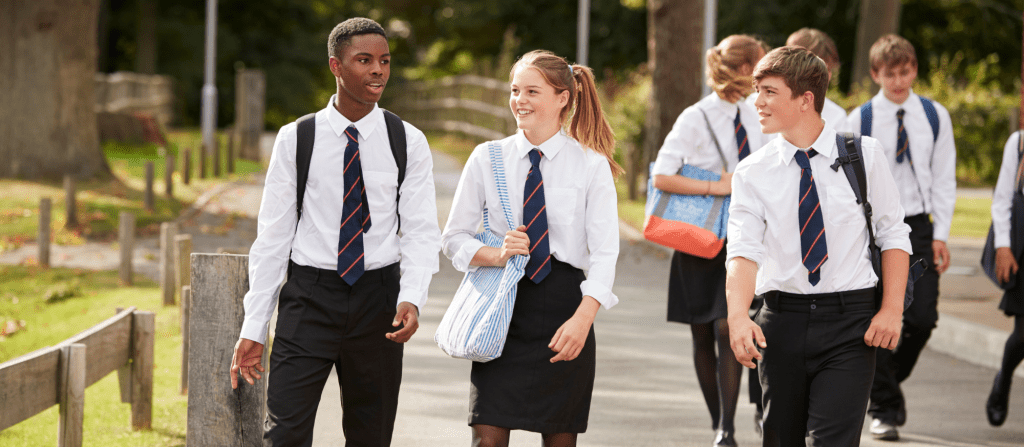
Uniform policies for Kids.

I’m not against having a school uniform policy—structure and consistency are important. It’s the over-focus on trivial details and unnecessary rules is where things start to go wrong.
It’s become ridiculous how much emphasis some schools place on skirt lengths. One mother is being threatened with suspension for her daughter simply wearing the longest skirt she could find that would still fit her slim waist. The skirt is barely above the knee—hardly a fashion statement, just practical. And yet, the school sees this as an issue.
How is this appropriate for school age kids?
What message are we sending? That a girl’s education is less important than her skirt length?
That she’s somehow “distracting” others or being “inappropriate” just because she’s wearing a perfectly decent skirt that fits her?
It’s hard to see how these rules are helping students focus on learning when they’re worrying about things like this instead.
Liam, a 15-year-old student at Strood Academy in Kent, was removed from class and placed in a behavioural unit due to his “extreme” skin fade haircut, which he needed for his eczema condition to keep his head cool. Despite providing medical information, the school enforced its policy prohibiting extreme haircuts, aiming for equality among students.
In recent years, there have been reports of female students being told to have their skirt lengths measured by teachers, causing discomfort and outrage. Take Caldicot School in Monmouthshire, where a 14-year-old girl was asked to stand in front of a male teacher to have her skirt measured as part of a uniform crackdown.
Then there’s Rainford High in Merseyside, where girls were lined up and their skirts measured by male teachers. This sparked protests from students, feeling humiliated by the whole ordeal.
Surely, teachers could be using their time more efficiently than worrying about the exact length of a girl’s skirt?
We’re constantly told about teacher cuts, shrinking budgets, and increasing stress for staff, yet somehow, measuring skirt lengths is worth the focus!
Meanwhile, actual teaching and student support take a backseat. Despite the emphasis on strict uniform policies, there’s no solid evidence they improve education. In fact, they often lead to stress, resentment, and disengagement.
How is this helping kids engage in school?
How is this encouraging responsibility? Common sense would tell you—it’s not.

And yet, despite all of this, some people still defend these policies. A family member once told me, “Schools have rules, and you have to follow them. No excuses!”
That same week, she was two hours late for work because the trains were cancelled.
I asked if her boss locked her in a room all day and refused to let her speak to anyone. She laughed. Because that would be ridiculous.
But for kids? Apparently, it’s fine.
Schools claim to prepare children for the real world.
But in what job would you face isolation for being five minutes late because of a flat tyre?
Would your boss ban you for having an emotional morning and arriving two minutes late, even after pulling yourself together?
People would be outraged if an adult gets fined for being late due to roadworks or a cancelled train. Yet, a mother got fined for exactly that when dropping off her child.
Schools talk about “preparing kids for life,” but in the real world, flat tyres, bad mornings, and traffic are just… life.
It’s no wonder so many students are disengaged. It’s no wonder kids can’t wait to leave. And it’s no wonder the research now shows these extreme behaviour policies do more harm than good.
Maybe it’s time schools stopped punishing kids for things that don’t matter—and started focusing on what actually does.
How Zero-Tolerance Policies Hurt Students
Research shows that strict zero-excuse behaviour policies aren’t just ineffective—they’re harming students’ well-being and making school a miserable experience.
The verdict? These policies don’t help kids learn—they just make them hate school.